Traditional art galleries offer prestige but come with rigid rules and high costs. Coffee shops provide flexibility but lack cultural depth. What if you didn't have to choose?
You need a space that doesn’t feel like every other venue in Manhattan. Something with actual character. Maybe you’re planning a product launch, a private celebration, or an intimate gathering where the setting matters as much as the guest list. You’ve looked at traditional art galleries—impressive, sure, but the pricing makes you wince and the restrictions feel suffocating. Then there are coffee shops, which offer flexibility but lack the polish you’re after. The question isn’t really which one wins. It’s whether you have to choose at all. Let’s look at what each option actually delivers, and where the gaps show up.
Art galleries are built for one thing: showcasing work in the best possible light. You get professional track lighting, white walls designed to make art pop, and an atmosphere that signals “this matters.” Coffee shop venues, on the other hand, prioritize accessibility and casual comfort. Walk in, grab a seat, feel at home.
The difference shows up in how people behave in each space. Galleries command a certain reverence. People lower their voices, move slowly, take their time with what’s in front of them. Coffee shops invite conversation, movement, and a more relaxed energy. Both have their place. The question is what your event actually needs.
Then there’s the practical side. Galleries in neighborhoods like SoHo or Chelsea average $147 per hour to rent, with larger spaces climbing to $628 per hour. Coffee shop venues in NYC run around $296 per hour. But pricing isn’t the whole story. What you’re really paying for is the experience your guests will have and whether the space can adapt to what you’re trying to create.
Here’s where it gets interesting. Some coffee shops have figured out that blank walls are wasted opportunities. We’ve built our space around the idea of rotating local artists’ work, creating a gallery experience without the formality. You get the approachability of a coffee shop with visual interest that actually means something.
This hybrid model has grown since the pandemic, when people started craving community spaces that didn’t revolve around drinking. These aren’t just coffee shops with a few prints on the wall. We curate our space where emerging artists get real exposure, and customers can buy directly from the person who made the work. No gallery markup. No middleman taking half.
The benefit for events is obvious. You’re not choosing between sophistication and accessibility anymore. You can host a gathering in a space that feels culturally relevant without the intimidation factor that keeps some people from walking into traditional galleries. Your guests can enjoy quality coffee, engage with real art, and feel like they’re part of something that supports actual creators.
What makes this work is intentionality. We don’t just fill wall space. We create rotating exhibitions, host artist talks, and build a community around both the coffee and the art. It’s a different energy than a traditional gallery, but it’s not less valuable. For many events, it’s exactly what you need.
One of the biggest anxieties in event planning is the guest count guessing game. You estimate 40 people, but what if 60 show up? Or worse, what if only 20 come and you’re stuck paying for a space that feels empty?
Traditional art galleries often have fixed rental fees based on square footage. You’re paying for the entire space whether you use it or not. That’s fine if you’re confident in your numbers, but it’s a gamble if you’re not. And if your event grows beyond the gallery’s capacity, you’re out of luck. Many galleries cap attendance to protect the artwork and maintain the atmosphere they’ve carefully cultivated.
Coffee shop venues offer more flexibility, but they come with their own limitations. Most can accommodate 35 to 50 people comfortably. Some have private rooms or sections that can be reserved without closing the entire shop, which helps with budget. But if you need a larger space, you’re looking at full buyouts, and suddenly the cost advantage disappears.
The real challenge is finding a space that can adapt. Maybe you need room for 30 people for a seated dinner, but you also want the option to open it up for 50 if the RSVP list grows. Or perhaps you want a space that works for both intimate gatherings and larger networking events without feeling wrong for either.
This is where layout matters as much as square footage. Open floor plans with movable furniture give you options. Fixed seating and rigid configurations lock you in. When you’re evaluating venues, don’t just ask about capacity. Ask about flexibility. Can tables be moved? Is there outdoor space that can extend capacity in good weather? What happens if you need to accommodate more guests than originally planned?
The best venues understand that events evolve. We build flexibility into our pricing and our space configuration. We don’t penalize you for success when your event draws a bigger crowd than expected, and we don’t make you feel like you’re wasting money if turnout is lighter than hoped.
Want live answers?
Connect with a The Café Galerie expert for fast, friendly support.
Greenwich Village and SoHo aren’t just neighborhoods with galleries. They’re the historic heart of New York’s art scene. Since the 1970s, artists have gravitated here, first to the East Village, then to SoHo’s cast-iron lofts, and eventually to Chelsea as rents climbed. Today, these neighborhoods still attract both established galleries and emerging spaces.
What you find here ranges from prestigious galleries representing major contemporary artists to smaller spaces championing local talent. The prestigious ones offer undeniable credibility. Hosting your event at a well-known Chelsea gallery sends a message. But that message comes with a price tag that can reach $20,000 per month for larger spaces, plus restrictions on everything from catering to guest behavior.
Smaller galleries and artist-run spaces in the Lower East Side or NoHo offer more accessible options. They’re often more willing to work with event planners on pricing and logistics. The trade-off is less name recognition, but for many events, that’s not what matters. What matters is the space itself and whether it serves your purpose.
The hybrid model isn’t about compromising. It’s about combining what actually works from both formats and dropping what doesn’t.
From galleries, you take the visual impact, the curated environment, the feeling that you’re in a space where art matters. From coffee shops, you take the approachability, the flexibility, the lack of pretension that makes people feel comfortable from the moment they walk in. Put those together, and you get something that serves a wider range of events than either format alone.
Here’s what that looks like in practice. We’re located on Thompson Street in Greenwich Village with rotating exhibitions from local NYC artists. The walls change monthly, so there’s always something new to see. The art is for sale, and when someone buys a piece, they’re buying directly from the artist. No gallery taking 50%. No markup that makes art feel inaccessible.
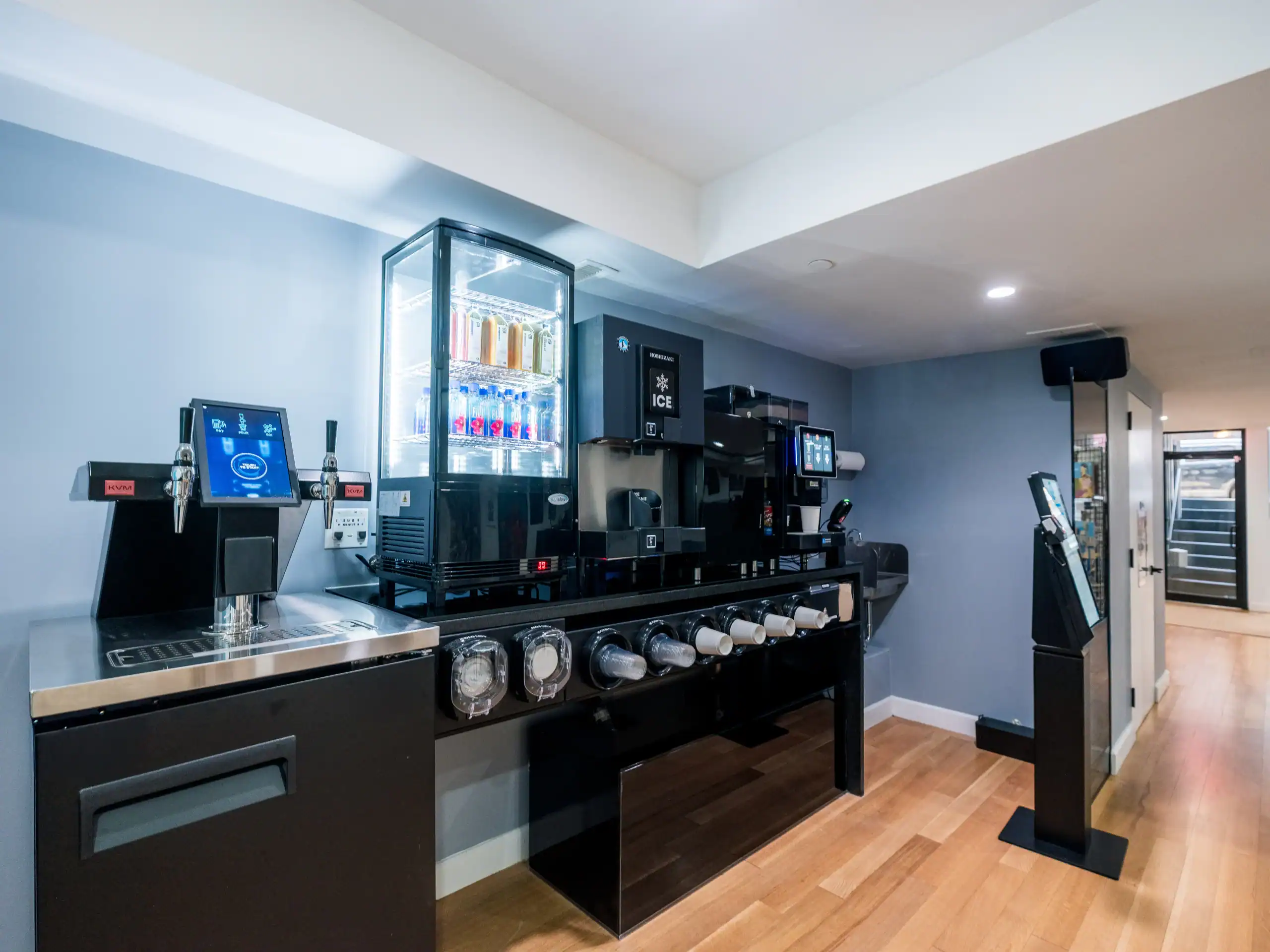
We’ve also added self-serve coffee technology. Not the kind that makes you wait in line for 20 minutes during morning rush. The kind where you walk up, select your drink, and it’s ready in under 30 seconds. Commercial bean-to-cup machines that deliver consistent quality every time, whether it’s 8 AM on a Monday or 8 PM on a Saturday.
The result is a space that works for a quick coffee stop, a two-hour work session, or an evening event. You can host an intimate gathering of 30 people or scale up for 50 without the space feeling wrong for either. The atmosphere shifts with the time of day and the way you use it, but the quality stays consistent.
This flexibility extends to pricing. You’re not paying gallery-level rates for a space, but you’re not sacrificing the cultural sophistication that makes an event memorable. We offer transparent pricing without surprise upcharges, and you know exactly what you’re getting.
When a venue combines dining and exhibition space effectively, it creates opportunities that neither format offers alone. Your guests aren’t just looking at art on the walls while they wait for their coffee. They’re experiencing both elements as part of a cohesive environment.
The key is integration, not just coexistence. Some coffee shops hang a few prints and call it a gallery. Some galleries add a coffee bar in the corner as an afterthought. Neither approach creates the kind of space that makes events special. What works is when both elements are designed to complement each other from the start.
Think about how people move through the space. In a well-designed hybrid venue, the art draws people in, and the coffee gives them a reason to stay. They can grab a drink, find a seat, and spend time with the work on the walls. For events, this creates natural conversation starters. Guests aren’t standing around awkwardly waiting for something to happen. They’re engaging with their surroundings.
The dining component matters more than you might think. Quality coffee and pastries from recognized brands—we partner with Magnolia Bakery—signal that this isn’t a space cutting corners. It’s a space that cares about every detail. And when you’re hosting an event, those details add up to an experience your guests remember.
For evening events, the space transforms. The lighting shifts, the vibe changes, and suddenly you’re in a venue that works for artist talks, live music, or community gatherings. The coffee bar becomes a social hub. The art on the walls provides visual interest that keeps the energy up. And because the space is designed for both functions, the transition feels natural rather than forced.
This is especially valuable for events that don’t fit neatly into traditional categories. Maybe you’re hosting a networking event that’s too casual for a formal gallery but too sophisticated for a standard coffee shop. Or a product launch that needs visual impact without gallery-level pretension. The hybrid model gives you room to create something that matches your vision without fighting against the venue’s limitations.
The choice between art galleries and coffee shop venues isn’t really about which one is better. It’s about which one serves your specific needs, and whether you’re willing to accept the trade-offs that come with each.
Traditional galleries offer prestige and professional presentation, but they demand premium pricing and come with restrictions that can limit your flexibility. Coffee shops provide accessibility and affordability, but they may lack the visual impact and cultural depth your event requires. The hybrid model—spaces that combine gallery sophistication with coffee shop approachability—offers a third option that eliminates many of those trade-offs.
When you’re evaluating venues, focus on what actually matters for your event. Capacity flexibility, transparent pricing, atmosphere, and the experience your guests will have from the moment they walk in. Don’t settle for a space that makes you compromise on the things that matter most.
We’ve built The Café Galerie at 168 Thompson Street in Greenwich Village to bring together quality coffee, rotating art exhibitions from local NYC artists, and a flexible space that works for everything from casual meetups to evening events. No pretension. No hidden fees. Just a space that works.
Summary:
Share: